Becoming a Grief Doula, with Dina Bell-Laroche | EP

What if the word "coach" isn't big enough for what grief actually needs? In this conversation, Dina Bell-Laroche walks me through the journey that took her from a devastated 29-year-old — grieving her younger sister Tracy, who passed from a rare cancer while pregnant with her first child — to becoming one of the clearest voices in grief and loss literacy today. We talk about why she moved away from calling herself a "grief coach," what a grief doula actually does, and how a disconnected rotar...

 Apple Podcasts
 Spotify
 Castro
 RSS Feed
 What if the word "coach" isn't big enough for what grief actually needs?
In this conversation, Dina Bell-Laroche walks me through the journey that took her from a devastated 29-year-old — grieving her younger sister Tracy, who passed from a rare cancer while pregnant with her first child — to becoming one of the clearest voices in grief and loss literacy today. We talk about why she moved away from calling herself a "grief coach," what a grief doula actually does, and how a disconnected rotary phone in a garden in Japan became the inspiration for a project she's now bringing to a hospice near Ottawa.
This one will change the way you think about "getting over" a loss — and about ranking your grief against anyone else's.
About Dina Bell-Laroche
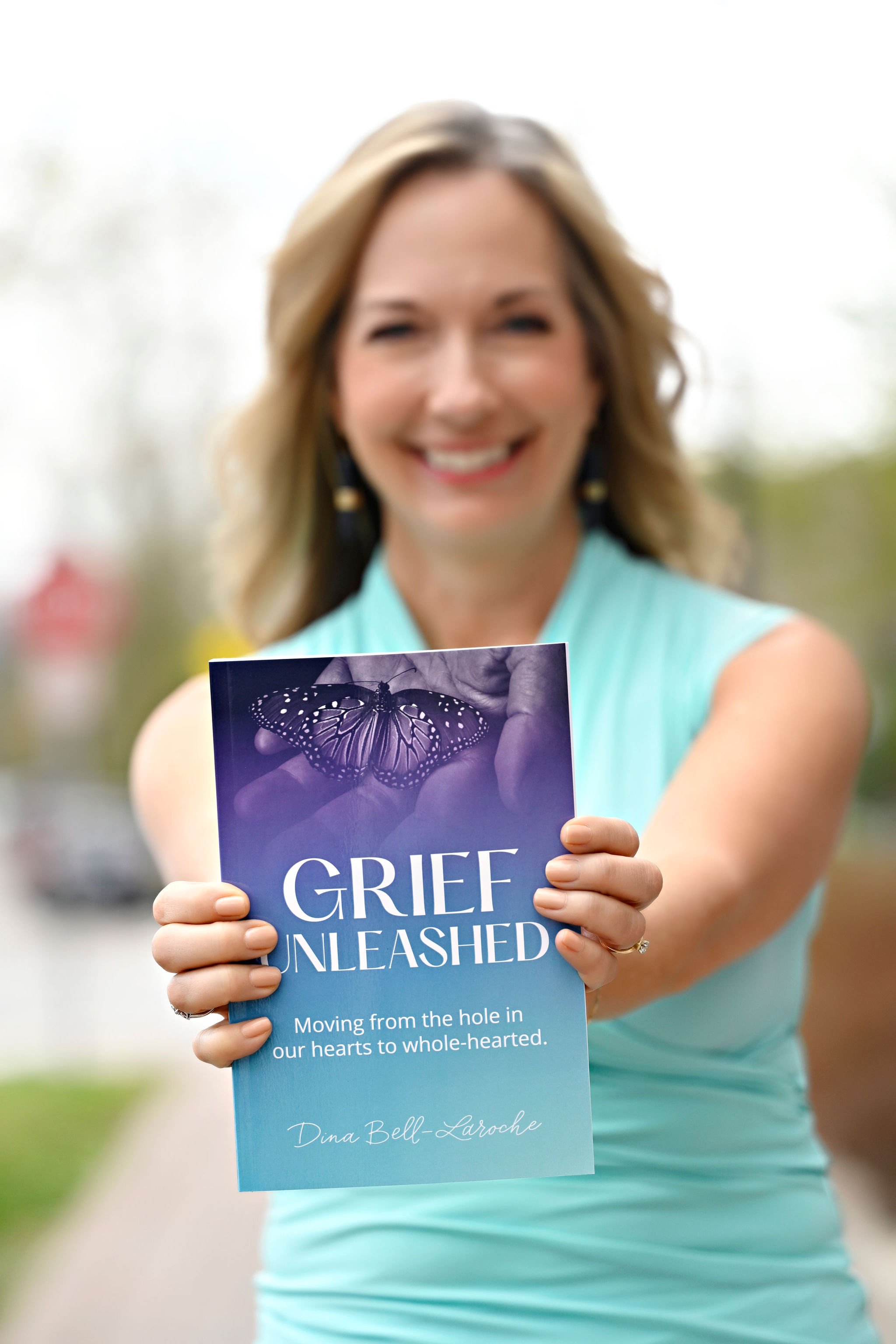
Dina Bell-Laroche is a Certified Thanatologist, grief doula, death educator, keynote speaker, and the author of Grief Unleashed: Moving from the Hole in Our Hearts to Whole-Hearted. Since her sister Tracy's passing in 2001, Dina has built classrooms in Nicaragua and Northern Ontario in Tracy's name, hosted dozens of Grief Cafés, and helped launch Ottawa's first Wind Phone. She writes The Grieving Place on Substack and works with individuals, families, and organizations — including elite athletes and executives — navigating grief and life-altering loss.
Connect with Dina:
Website: https://www.griefunleashed.ca/
Substack — The Grieving Place: https://dinabelllaroche.substack.com/
Instagram, Facebook & LinkedIn: @griefunleashed
Book: Grief Unleashed: Moving from the Hole in Our Hearts to Whole-Hearted
In this episode, we cover:
- The difference between chronos time and kairos time — and what STUGS (sudden temporary upsurges in grief) really are
- Why Dina moved from "grief coach" to "grief doula," and what that shift means
- Disenfranchised grief, and why sibling loss so often goes unacknowledged
- Why our culture ranks losses against each other — and why that hierarchy needs to go
- Talking to children honestly about death
- The story behind the Wind Phone, and Dina's new Wind Phone project at a hospice in Ottawa
- What the Grief Companion Program actually looks like
What resonated with you? Have you ever felt like your grief wasn't "bad enough" to talk about? Drop a comment and let's talk about it.
You've been listening. You're doing the work. But there's still this feeling that you're circling the same place.
Maybe you've thought about working with me one-on-one. Maybe something's held you back.
I get that. And I want you to know there's still a place for you.
All of it, pay what you want. You decide what it's worth. Nobody gets turned away because of money.
The International Association for Near-Death Studies or IANDS will host its annual conference at the Hyatt Regency in Bellevue. The event features an all-star lineup of keynotes like Proof of Heaven Author Eben Alexander, MD, and Dying to Be Me Author Anita Moorjani. I Early bird registration rates are available through July 15.
Visit IANDS.org to register
The International Association for Near-Death Studies or IANDS will host its annual conference at the Hyatt Regency in Bellevue. The event features an all-star lineup of keynotes like Proof of Heaven Author Eben Alexander, MD, and Dying to Be Me Author Anita Moorjani. I Early bird registration rates are available through July 15.
Visit IANDS.org to register
Want to go deeper? My Substack is where I share solo essays on grief, consciousness, and continuing bonds — thoughts that don't always make it into the podcast. It's also home to a community of listeners who get it, because they're living it too. Free to subscribe. Find it at substack.com/grief2growth.
🧑🏿🤝🧑🏻 Join me on Substack- connect with others and me
👛 Subscribe to Grief 2 Growth Premium (bonus episodes)
📰 Get A Free Gift
📅 Book A Complimentary Discovery Call
📈 Leave A Review
Thanks so much for your support
Close your eyes and imagine. What if the things in life that caused us the greatest pain, the things that bring us grief, are challenges. Challenges designed to help us grow to ultimately become what we were always meant to be. We feel like we've been buried, but what if, like a seed, we've been planted? And having been planted, we grow to become a mighty tree. Now, open your eyes. Open your eyes to this way of viewing life. Come with me as we explore your true, infinite, eternal nature. This is Grief to Growth, and I am your host, Brian Smith. Hi there, welcome to Grief to Growth. I'm Brian Smith, and whether this is your first time here, or you've been with me for a while, I'm glad you found your way. This show exists because I believe grief doesn't have to be the end of the story. It can be a doorway into deeper love, deeper meaning, and a life more fully lived. We asked the hard questions here. What happens when we lose someone? What does it mean to grieve well? And what if the people we've lost are still closer than we know? Dina Belaroche is a woman who decided, in the depths of her own grief, to become someone who could light the way for others. When her younger sister Tracy passed away in 2001, Dina's world cracked open, and rather than seal it shut, she leaned in. She became a certified Thanatologist, a grief doula, a death educator, a keynote speaker, and the author of Grief Unleashed, moving from the whole in our hearts to wholehearted. She's brought Grief cafes to communities, built classrooms in Nicaragua and Northern Ontario in Tracy's name, and most recently helped launch Ottawa's first wind phone, and we'll talk about what the wind phone is today. Like me, Dina knows what it is to carry a loss that reshapes everything, and like me, she's chosen to let that loss mean something. In this conversation, we'll talk about what it actually looks like to grieve in a culture that doesn't know how. We'll explore why the phrase, I'm sorry for your loss, is both well-meaning and quietly harmful. We'll get into the difference between a grief doula and a grief coach. What a certified Thanatologist actually does, and why Dina brings grief literacy into the world of elite support. And we'll talk about creativity, how building a classroom, writing a book, picking up the wind phone, can all be acts of love that reach across the veil. So if you've been quietly carrying your grief, wondering if you're doing it right or wrong, or if anyone else feels the way you do, this episode was made for you. And if you'd like to continue this conversation after the episode, head over to grief2growth.substack.com. You'll find an article there about today's discussion, where you can comment and connect with me and other listeners. And with that, I want to welcome Dina Belaroche. Thank you so much for having me. I'm really delighted. Yeah, we've talked a couple of times before, and I'm really looking forward to continuing our conversation today for the people of our podcast. Before we get into all the other stuff, though, tell me about your sister. Well, thank you for asking about her right at the top and for naming her. You know, that's often something that that really opens up the briefs hard is when we invite them to speak their person's name. So often we'll talk about our daughter that died or our parent or our sister or sibling, but we don't actually use their name because it hurts so much. And yet when we do, it makes it real and profound and we can be witnessed in that experience. So thank you for for modeling that I'm really grateful. And so Tracy was a 29 year old mom. She she was she wasn't actually a mom yet. She was pregnant with her first born. And I had a three month old baby in my arms and she was experiencing a lot of duress and in January of 2000. So just at the top of, you know, the millennial, we were worried that the world was going to be on fire as she ended up in hospital. And within 48 hours, we went from really excited that she was going to have her baby to an emergency C-section and discovering that she had a 14 pound tumor that was growing right alongside her baby. The kind of cancer she had, Brian, was so rare. Only 220 people around the world had that kind of cancer. It's a childhood cancer, actually, a Ewing sarcoma and the trajectory of her illness. You know, it was it was, I'd say, amongst the hardest thing for me and my parents and her husband and our family and friends to witness. Giving birth to a baby hosting a her her shower in the hospital before he was born. And then the the ups and downs of the roller coaster ride that is a a long illness until she died 13 months later, just after her baby had turned one. So it, you know, it was really, I would say there's a before, and I'm sure people will resonate with this. There was a before Tracy died and an after. And I didn't have the language. People didn't come to us, Brian, and say, OK, Tracy's family. Here's what you are likely to experience. Here are some of the things that are a normal part of the grieving experience that will accompany her life altering trajectory. Nobody told us that she was dying. Like we didn't we didn't have these really hard but ever important conversations that then truncated our grief and had us retreating into our respective grief caves that that didn't didn't really help us feel seen, heard, valued, appreciated for the experience that we were going through. And it didn't give Tracy permission to actually talk about all these fears that she was holding right alongside the hope. Right. So in large part of because of this experience and we'll probably get into it because it wasn't wasn't like, oh, yeah, I'm going to become a grief advocate. It was I don't know who I am anymore. And while I was reassembling the pieces of my broken heart, because Tracy was one of, you know, the favorite people on the planet and it's been twenty five years, but it feels like yesterday at times. Right. That pain that arises, these stugs, these sudden temporary upsurges in grief, which connect me back to that pain of of her death. And yet, you know, because of this belief in our love and that love injures and and energy changes form, it doesn't just disappear. I'm stubborn and committed and loyal. And it just felt wrong to not talk about her, to not keep her memory alive, to not find ways to teach my three children about their anti titty, to not do things in her memory that would make the world a better place, to not continue our bond, which is this beautiful theory in grief, in grief work that talks about how death ends a life. It doesn't have to end a relationship. So, yeah, that's a little bit more about Tracy. Yeah, thanks for sharing that. And you said something there that really, really touched me. You said, you know, it's been twenty five years, but sometimes, you know, those things still come up and it feels like yesterday. I was talking with someone a couple of weeks ago and he said, I'm sorry for the loss of your daughter because but I know it's been a long time as if like that meant it was somehow diminished or reduced or something. And it's important for people to know you say it's been twenty five years, but that doesn't mean that Tracy is diminished from your life at all. Yeah, yeah, exactly. It's like twenty five years and a day. You know, our bodies understand a different language than our head does. And I suspect that this will really resonate with you. We understand chronological time, chronos time, right? So we can understand that twenty five years is a long time. We could do the grief math and, you know, three hundred and sixty five days times twenty five. That's a lot of days. It's a lot of miles. It's a lot of tears. It's a lot of joy, though, that has also been, you know, a part of our journey. And yet we also have Kairos time. This is this liminal space that you and I dance in. It's when we are connected to maybe the universe in a way that that our bodies understand. So bodies understand time and touch and movement and breath. Right. That's the language of body. And so when we are finding ourselves back in a moment that brings me back to the moment when she took her last breath or the moment that she gave birth to her son and we were watching this right. To the moment that she was my maid of honor and I was hers, like all of these little moments that then come in to our sphere and into our hearts. That's Kairos time and that Kairos time needs a different language. So these stugs that I referenced, right? The sudden, temporary, upsurges and grief. That's the language that our body understands. And usually it's activated when there's a memory, could be a smell, it could be a feeling, a sensation, could be somebody that walks by you and you're like, that's my daughter, that's my sister, that's my person. It is a felt sensory experience that transcends the intellect. But our body understands it. So stugs, you know, which was coined by Therese Rando, who's a thanatologist and a bereavement expert, that language brought so much healing to my heart because I felt seen in that experience, language opens up worlds, right? Language connects us to our lived experience. When I read stugs, I went, oh, I thought it was going crazy. So I often share with people, stugs, they feel like a panic attack, right? You could be shopping and all of a sudden you walk by the cookie aisle and there's your person's favourite cookies and then all of a sudden you're e-pray loving on the floor and you're like, what just happened to me? They dissipate with time. Here's the other thing I'll share, though. With all respect to Therese Rando, I would offer that stugs can also stand for sudden temporary upsurges in grace. I have fallen to my knees experiencing such profound moments of joy. I think grief opens up our heart, our chakras and makes us more porous, more human, you know, instead of denying and suffocating and suppressing, we we lean into a human experience and we're touched by what it means to be human. We are acutely aware that our time on this earth is finite because we've suffered through so much profound pain, right? In this Kairos time space, I think that these sudden temporary upsurges in grace allow us to connect not just with ourselves and our person, but also the entire universe and planet. And in these experiences where I've fallen to my knees, it's always been in nature. And nature doesn't discriminate. My trees, as I call them, are my sentinels. I feel this downloading, this upsurge in love. I feel warmth and connected and I have no energy to stay upright. So I'm like falling to my knees and just in this experience, usually they last about 90 seconds before I know that I'm in the experience. And then as soon as I become conscious that I'm in an experience like this, it starts to dissipate. And I'm left wondering like, no, no, come back. I want to I want to I want to savour this. So it's you know, I haven't had these extraordinary experiences like maybe maybe half a dozen times or so. But they're they're becoming more frequent, Brian. And I think it's because I'm doing the work of opening up my heart of giving myself permission to to not have been the one to die. Because when your sibling dies, your I was wondering why her and not me. We have the same parents. We have the same lineage, the same blood coursing through our veins. How is it possible that she ended up with this rare disease and I didn't and as a bigger sister, the only one that was going to pick on her with me. So a lot of feelings of shame, of guilt, survivor guilt, which I have, you know, I'd say I'd make peace with. I've let go of this need for me to have to live life times two. Now I'm living life times one still in honour of her. There's more room for me, though. And because of that, I think I'm accessing different levels of compassion that were unavailable to me before. Interesting. Yeah. Yeah. Thanks for sharing that. So when you went through this process and there was obviously some things you thought could be done better because you said, I'm going to become a certified than thanatologist, a great doula. Let's explain some of these terms that we threw out in the introduction. Yeah, I love that. So I had no idea what than otology meant. So let's let's deconstruct that. Ology is is the study of the biology. Thanos Thanatos is the Greek god of of death. So if you go back to Marvel, right. We all know that from the Marvel movies now. Exactly. Yeah. So God of death. So so there's a whole field of study called Thanatology. And I didn't I didn't even know what the word was. And I'm a journalist by trade, right? I studied journalism. So when I came into the landscape of this and wanting to understand this more from a place of like, oh, so it was beyond curiosity. Now, it was a bit it was activating the me this deep desire to advocate. I'm taking you back to about 20, about 2015, 2016. So Tracy died in 2001. In 2011, I read a book that changed my perspective. It was by Dr. Alan Wolfeld, who's recognized as a grief educator. He's a psychologist and he's written, I don't know, 35 books on grief and loss. And his book Understanding Your Grief changed everything for me. There was this opening up, this permission granted, this ability for me to really understand that what was happening to me was a normal part of being a bereaved person. Right. There was nothing wrong with me that I wanted to continue my bonds. In fact, you know, Dr. Wolfeld applauded that. So that was the beginning. And then I started reading other things. I started to recognize that sibling loss is part of the group of disenfranchised grievers, right? A lot of children, people with intellectual disabilities, often people of color, often disenfranchised in their experience and expression of grief. So because I'm so curious and then I'm a bit of a social justice warrior, I began to see the group of bereaved people, which is, heck, all of us on the planet as people who are not being nourished by the language of loss. And so in 2019, just before, as I turned 50, I had named 50 things that I wanted to to experience. And one of them was to learn under Dr. Alan Wolfeld. He had a four day companioning the bereaved course in Colorado. So I flew from Ottawa, Canada to Colorado as part of my 50 by 50 living intentionally on the planet. I came back from that experience and I was like, OK, I actually want to do this vocationally, my soulwork. I didn't know what that was going to look like. I knew I had a book in me to write. So I sat underneath my tree and I the backstory doesn't matter. But a woman by the name of Laura Traplin was who's a medium. I met with her and from her location in mine online, right, just on on a call, her first words to me were and this is before I started writing about this publicly. Her first words were Dina. Does the word death do mean anything to you? So I took that as a sign. I enrolled in a thanatology program. I've just completed my 12th thanatology course, which you know, academia. It's not easy for now. I'm 57 to go back to school and study this vocationally. Along the way, I became aware of the profession of thanatologist. And it's important for me to hold this with integrity and reverence. So I certified as a professional thanatologist with the Association of Death Educators and Councillors out of the US. So I'm part of this guild, this sisterhood, brotherhood that really is about reclaiming our humanity through the prism of lost literacy. Because here's what I've learned, Brian. The more I do the work on myself and meet my grief from a place of grace, the more I'm feeling less distracted. I'm not turning to things that are going to numb my pain. In fact, I can stay more open to the source of my pain. My ego then becomes a little less protective. And so I can work on my own way of being and seeing and acting in the world from a place of love for myself and reverence for others. So this work of thanatology has really shaped the person I've become the way I parent my now three adult children, the way I spouse. You know, I've married my high school sweetheart the way I companion others, the way I teach. I offer a program where I can teach people how to become companions. And I would say I'm a leadership coach, so I'm certified as a professional leadership coach. And this lens through which I companion my clients, executives, athletes, other sport coaches really has shifted because what I've started to appreciate more fully is we become attached to people, identities, experiences. And when that attachment is severed, that's when grief arises. Right. So it's just really been, I'd say, a beautiful way for me to be a human on the planet. Yeah. Yeah. So the thanatology, is that more it almost sounds like a medical thing. It's not it's not from a medical perspective. Is it more from helping people grieve? Is that what it's about? Yeah, I love that you've raised that. So as a thanatologist, we become really acutely aware of the death trait. There is a system I think of like funeral practitioners. Think of hospitals. Think of the way in which we dispose of bodies. Right. So think of the death as a system. OK. And post World War Two, we became allergic to anything related to grief and loss. Yeah. Before World War Two, we didn't have the luxury of denying death. We had we had different practices in place. We had rituals and community. Black meant something wearing black meant something. Right. We have since post World War Two, I would offer become really allergic as if denying death and loss is going to prevent it from happening. So because of that, I think the field of thanatology informed by psychology has evolved and emerged in response to the denial of death, the suppression of death. Modern day grief theory is a reclamation, if you will. It's out there trying to inform people, educate people. The other thing I'll share is the medical model and North American kind of approach to what what illnesses and is is much more interested in fixing problems. It's diagnostic in its nature. The work that I do is much more about whole human care. We are coming into systems, medical model systems and saying, hey, human to the doctor, what's your relationship with grief and loss? Right. So there's a reclamation on foot because grief is not a pathology in this DSM, right? So DSM five, which is the bible of all that ails the human heart. Grief is only there as a small little, you know, ailment that affects a very small percentage of the population. And even then, those that are certified as thanatologists and educators, we kind of bristle at the term pathology. We bristle at the at the word prolonged grief as a disorder. Yeah. The analogy I give is if a woman's having complications and her birthing experience, we wouldn't say she's suffering from prolonged birthing disorder. Right. So there's there's a lot of education reclamation that I think that I'm a part of as a thanatologist. We're advocates for a more informed way of being with grief and loss. That's that's awesome. One of the things I realized now I had thanaphobia when I was a child. I was scared of death. So that's where I know the Thano prefix from. But and I realized in our society, as I got older, that we don't we don't talk about death. Most of us, a lot of us have never seen someone pass. A lot of us haven't seen a body. I remember my father saying when he was younger and if someone passed away, they had a parlor in the house and they'd lay the body in the parlor and the body would stay there for a few days. And now the body's whisked away. And we never we know we might see it at some point. But we're just we're just as you said, we're really uncomfortable with the idea of of death. And doctors are taught that death is the ultimate failure. Right. So their role ends when the body stops. That's that's the end of their their thing. And then they feel like they've they've lost. And we've been taught to fight death with everything because it's it's the enemy. And when it's like it's the only thing that we all know is going to happen to all of us. So the denying it is is really that's the that's the problem. And I'm glad to see there's emphasis being placed on how do we make this integrate this into our lives? Yeah, that's beautiful. And I would say we have to ask ourselves, why? Why have we been conditioned to deny death? And so Philip that he is, which is a he wrote the hour of our death years ago. So I would encourage any listeners to go in and become more informed. Why are we not talking to children about this? So many parents come to me and say, how how do I talk? How do I deal with this? Should I bring the kid to the you know, to the funeral? The child's part of your family system. Denying it just actually makes them feel so many of my clients have had really bad experiences when they were younger related to death and loss, which contributes to the fear, right? Children know how to grieve. They come on our laps. They're crying because they were something was taken from them. Right. Yeah. Body's response to that severed attachment. So why aren't we talking about this? And here's my take. Capitalism or post capitalism right in our structure wants us to keep producing and consuming. Yeah. Yeah. Death and grief and loss. It interrupts that focus, that denial, that numbing that sets in when we're wounded. Right. Trauma, a wound to the soul. So I think in large part, as we're now starting to kind of like set up straighter and question structures, one of the things that we become more aware of is our tendency to numb to distract. And so if we when we do the reclamation work, we start to ask ourselves, well, of course, our systems and structures have put metrics around grief and loss. I'll give you one example, Brian. So we tend to compete with each other's losses, right? We will understand the death of a child is like the hardest experience to navigate. And then underneath that might be death of a spouse, death of a parent, death of a sibling, death of a cousin. Like we order our grief in this so-called grief, our key. Yeah. Yeah. It's not necessary. You know, if there's one time that we should be given a whole pass, it's when we have navigated loss, the loss of someone we care about, or it could be the loss of identity. Right. And we're doing a lot of workforce adjustments right now. And I'm sure you're traveling through that as well. It is, it is incredibly heart wrenching work when someone is told, here's your pink slip. Thanks for coming out for the last 30 years. So I think that there's, you know, a lot of what we're speaking to when we understand that our systems and structures designed mainly post-World War Two, modeled after a competition and a command and control model, military, corporate. It gives us five days for a child, four days for a parent, three to eight. Like we tend to be reductionistic in our approach. That is a human experience that shifts and shapes everything that we are. So a part of the work I do when I'm doing corporate culture work is we come in and do an audit and inventory of their so-called human relations practices. Show me how you care about people who have suffered through a life altering loss, and I'll show you whether or not your culture is thriving. Yeah, that's a really good point. And, you know, talk about the hierarchy of when we lose someone. Yeah, we tend to do that and we think, you know, the loss of a child. I remember one time I was talking and I actually slipped up and said this to this woman, I said, you know, the loss of a child is the worst loss you can go through. And she said, no, she said, I've lost a child. She lost a son. She goes, and I just lost my spouse recently. And she said, I can tell you losing my child was no worse than losing my spouse. And I've been working with a lot of people recently. And I work, I work a lot with people who lost children because of my experience and working with helping parents heal. And lately I've been dealing with people who have lost spouses. And it's a different loss. I wouldn't say it's better or worse. It's different because as children grow up and they move away. But our spouses are that person we expect to be there, you know, every day for the rest of our lives, the person that we wake up with. So it's a different loss and losing a sibling. As you said, that's one of the losses that we kind of like put us. We rank that one down low. So we don't acknowledge that that's that's just as important as losing, you know, a parent or a child. Yeah, I love you. You just said it perfectly. It's an important, significant, significant, meaningful loss. So often I will say to people when I'm doing my grief education is let us allow the loss to lead the way in this community. In this conversation, we don't have to compete or compare or contrast. We can just allow our laws to be the most significant loss for us in this moment. And you can do the same. And our broken hearts can meet each other in that field. Yeah, exactly. I always think about this, the one guy that called me up and in our first meeting, he's felt my intake for him and he said he had lost his best friend. So in our first meeting, we're talking and he mentioned he lost his cat. And I said, this poor guy's lost his best friend and his cat. Turns out it was his cat. His cat was his best friend. And he was coming to me because he lost his cat. But pet loss sometimes we don't acknowledge. And I have people say, well, is that is that a real kind of grief? Is, you know, I'm like, yes, our pets can be closer to us than many humans are. You know, your pet is the one that loves you unconditionally. Your pet's the one that's always there for you. Unlike your children, they're not going to grow up and leave you. Unlike your spouse, you know, they're not going to divorce you. You're that's that's unconditional love. So that's that's extremely important loss. It's important that we point that out. Yeah, that's beautiful. Well done. Well, well done on the companioning. That's like a plus plus. Well, you know, it's like I said, you know, and then you as you get into this field, you learn that you expand the definition. It's not just losing a person. It's not just losing a pet. It could be the loss of a job or an identity. Yeah, I have a friend that he was he wasn't really let go. He was given an early retirement. And I'm like, we should be happy, man. You know, you got to retire and they gave it gave you a bunch of money to leave. But it was a loss of identity. It's like this what he had known for 40 years. And suddenly it's like they felt like they didn't need him anymore. So that was a stuff that was, you know, a grief that that he had to go through. Yeah, I'm so glad you raised that. Because when I think of when you just talked about retirement this is the truth that I witnessed when I'm with athletes, for instance. So many of them are retiring or retired at a very tender age. Right. I'd say the athletes I see are between the ages of 28 and 40. Yeah. So young. Right. And they are coming to me because nobody else in their world really understands what is happening inside of them. So typically when we're feeling bad, we turn to a therapist or a psychologist. If we even allow ourselves to do that. So many of the athletes I work with have been conditioned to control the mind. Yeah. Mental performance. Right. So I help them understand grief is an embodied experience. Your social, your interpersonal, your body, your mind, your spiritual way of being. So understanding grief is an omnidimensional experience, helps them understand and deconstruct from just this is something I'm just going to get over. I'm going to plow through it because that's what helped me be the elite athlete that I was for over 10 years. Right. Right. So when we understand that, you know, the dimensions of our grief and we invite our grief to come to the table and teach us what it means to be human now, now in this body that has let me down. So there's often a lot of anger towards our body. Right. In the case of people who I'm working through with workforce adjustments, there's a sense of betrayal, a sense of who am I now? A sense of wondering into like this next chapter in their life. So I get them to visualize their life as chapters. Yeah. And I also open up the space for, you know, how do we, we have to learn how to say goodbye before we can say hello. So how do we want to say goodbye? So often what we'll do is co-create ritual. Now, I think you'll love this, Brian. So we have routines, right? So when someone you love dies, might be your spouse, you have to unlearn the habit of waking up in the morning, going to make their bed or kissing them or making them coffee. Right. That those are routines that you have fallen into. Right. Right. You you have like just they have just become your way of being. Rituals are different. We step into ritual with intentional. These are intentional actions that are symbolic and derive a new sense of meaning. So ritual, we know from centuries of work, it's in our bodies. We can curate these rituals to help us understand what has just happened to me. How do I want to be in this experience of transition? Because that's why it's so scary. And then in what ways can I understand and give myself space and grace to travel through these unknown waters? It is such a compassionate, skillful way of being when we're navigating transition. But who's talking about it this way? The way you and I are talking about it, right? Yeah, well, again, it's this idea of you said, it's basically if a tie is severed. Loss of identity, a job, a person. It's it's a similar process that we're going through. And you put it very well. And then we have these these routines that we're in. And I'm a huge sportster. I love watching sports. And, you know, as a kid, I watched sports and they were all older than I was. And then they were about my age. And now they're all like, you know, of course, much, much younger than I am. Right. And I and now I have sympathy for these guys that are, you know, 35, 40 years old, if they make it that long. And it's like you've been playing the sport since you were five years old. It's been your entire identity. You use your body. You know, that's that's that's your identity. And so sometimes we can criticize on the outside. Why are they hanging on so long? Why don't they just why don't they just retire already? That's the end of an identity for that person. 100 percent. And and they haven't likely. So when we think about the boomerang, so they retire, then they come back. They retire, they come back. It's because of the relationship. They don't want it to be severed. It doesn't feel like we don't consciously complete our time. So this is where ritual I talk about. So I've worked with teams, right? So teams who, let's say they were vying for the gold and now they're fighting for, you know, bronze in the span of what, 48 hours. Yeah. Yeah. Yeah. So you have to find ways to and athletes typically are conditioned to compartmentalize, put it behind you, suffocate, suppress. Well, that doesn't work for everyone. And so now we're conditioning. Why? Because we've been told and we've inherited practices, military practices that this, you know, engages us from our hearts. This engages us from others. This is what helps us do what we do when we're military personnel. Yeah. Yeah. So we need to understand and say, well, that may have worked for that, but it doesn't have to work for how I want to be able to tell my teammate who's suffering, because this might be her last game ever on the pitch in front of the whole world. And now she's never going to win the gold medal. Or even if she does, part of what I help them understand is the pain, as you said, 10 years, 10,000 hours is what we often say it takes to be at that like ultimate level. Right. And when you're shaping young minds and bodies, this is all they've known. It's their entire way of being. So, of course, we can give them a moment to figure out how do I want to close off this chapter in my life with intention and grace and compassion, saying goodbye requires so much courage. And then that gives me space to stay, to say hello to the new me. So I work with them on both ends. That's what she does, right? Yeah, that's beautifully put. And I love the parallel between that and the fact of, you know, when we lose a person, you know, we there's a there's a part of that that life, that physical connection that is over. And we've got to learn how to close that out so we can move on to the next chapter. And the thing is, it's not it's not the end. And that's that's, I guess, the old grief model is like it's the end. Put that relationship away. You know, just just I think Freud even called it was like it was like an addiction on those. And I remember when they put the prolonged grief disorder in the DSM five reading some some professionals were very excited because they thought, well, if it's a disorder, then maybe we can find a pill and if we can find a pill, we can treat it just like we do depression, right? So we'll just we'll just get people this pill and they'll get over their grief. And anybody that's gone through a grief event, first of all, we're like, I don't want that pill even if it exists, because the only way I'm going to get over my grief is if I forget them, and we don't want to forget them, and we don't want to let go of the relationship. So we're asked, so we talked about there was a couple of times we mentioned we covered thanatology really well, let's talk about what a grief doula is, because that's that's a term that might be new to some people as well. Yeah, beautiful. So I started using the word grief coach in about 2020, right in the pandemic, because I was offering these grief cafes. I thought to myself, what's one thing I can do to help, right? And I was absorbing all of these things. I hadn't written my book yet, or the book had not written me yet. It was in me to give birth to but yeah, so I was out there and and just, I use the word grief coach. Why? Because I'm an integral master coach. I by then I had, I'd had almost, I don't know, eight or nine years of coaching, it was familiar to me. And what do we help you go from A to B, we help you set your goals and objectives and, you know, strive. The word coach though, I've I've moved away from it. And here's why, because grief, our grief really doesn't need coaching, it needs nurturing, it needs witnessing, it needs time and space. And so the word doula kind of dropped into my heart, when I was curating my sub stack back in 2022. And I, the word doula means to be a servant too. And so I'm a leadership coach, so I'm familiar with, you know, constructs around servant leadership. I, I have been working with this idea of beyond fixing, which is the medical model and the helping profession, which disempowers often people because we'll often say here, let me help you. So we position it from me and we see people often as broken and wounded. When we are in the serving mindset, we're actually seeing the whole person first and the patient second or the wounded second. We're like, you're already whole and beautiful. You might feel broken, but it's called grieving. And I can support you through that. But you lead, I follow that very simple way of showing up, it's our presence, Brian, right? And you know this because you, you exude such a beautiful quality of presence. That's what wounds do for those of us who are, I'd say courageous enough to stay with the pain. Something shifts inside of us, right? A level of consciousness becomes more available to us because where we are wounded is truth. It's like drinking from the nectar of this well of grief that David White, the poet speaks to. Very few of us will dare to go down. Most of us are throwing coins, wishing for something else. David White reminds us that the well of grief is like, it's hard work to go down into the deep, deep, deep, dark waters of this well. But when we drink from the, I'll call it the nutrients of this pain, it shifts and it allows us to live into our purpose with so much more clarity, compassion, kindness. So for me, the word doula feels more respectful, more accurate. And as a journalist, I want to be accurate than the word coach. Now, having said that, depends on who my audience is. If I'm working with a senior executive, they're coming to me usually as a coach to help them fix problems, diagnose, right? Right, right. And I would say every conversation, you know, we talk about silver linings. Every conversation usually is infused, even if it's very minor with a flavor of loss, because even if they're transforming, let's say they're in transformation or they have to fire, notice the language terminate someone so violent, right? This language, I can, I can acknowledge and I, if you were to ask me, how do I know? I just know. There's usually a moment when I will, I will acknowledge, you know, Brian, I see that you're, you might, are you in pain? What about you, the CEO, are you suffering from this, this conversation that you now need to have with another human that you've come to care about? And in that moment, they, there's usually a, you know, the eyes open up and there might be an expression of emotion. And I'm like, Hey, I'm here. That emotion needs to be processed. If you suffocate and suppress it, it's going to come back and anger, maybe burnout, right? So if you want to talk about that, we can do that too here in this session. So this loss literacy gives us a capacity to human others. Yeah, it makes a lot of sense. And it shows how that applies across things, right? So we talk, we start, we're talking about grief with people losing a person. And we know we applied it to people losing a job to someone being forced to, you know, take someone else's job away to, you know, it's the same kind of process. And I love when you talked about the no grief coach, uh, you know, trying to, when I started doing this, like, what do I call myself? Well, everybody knows how I heard the term life coach. So it's like grief coach. And I talked to a guy who was helped me with some marketing stuff. He said, how about grief guide? And he said, because it's like, um, he said, you're like the navigator. And it's like, I told my clients, it's like, like you're in the driver's seat and I'm the navigator. So, you know, you're, you're the one that's in control. And, and I like even the do-load thing even better, because what I've realized is I'm not really trying to get them someplace. Uh, it's like they're, they're already there and it's really, I love being able to work with people because when I, when things I really spend most of my time doing is saying you're okay, where you are is okay. The work you're doing is great. The things you're doing, even without me, I just got an email from a client earlier today and she's telling me about all these things. And she's so aware of what's going on and like all of her relationships and, and, and she's really, you know, examining herself and figuring out, okay, this is why I do this. And I'm not telling her these things, it's just coming out of her. And I love being there. Just, and I'm just there basically to witness those things. Yeah, it, the metaphor. So you're, you're, you've just used the metaphor of a guide and, and then I was starting to think of us as compasses, right? Like they're, they have agency. We see that in them. Yeah. Coaching move, right? When people who aren't in the chaos of the emotion and the experience and the physical sensations, when someone who's traversed, not the same path, but their path of pain. When they, they hear us saying, you will be well, keep going, and I'm here to support you. It's like we're a compass or the other metaphor I use often is the lighthouse. Yeah. Like the ship and the captain, that lighthouse is just there as a reminder, safety is here. Can I be the safe haven for you when all else is telling me to move on, put it behind me, get over this experience of this person that I love or this job that meant everything to me. And you're earlier noticing around fear. The fear of death is an, and usually it's subconscious. For example, it's not, for a lot of us, it's like, you know, we're both fascinated by death and scary movies. Think of scary movies. Yes. And we have this aversion to it at the same time. Yes, exactly. Yeah, exactly. I think you're right. For most people, it is unconscious. It's it's it's something what we talked about in the very beginning. It's something we don't think about, even though we watch murder movies all the time. We watch people being murdered. We watch all kinds of stuff, but we don't think about it ever happening to us or someone in our, you know, that we love until, until it does. And then we're shocked. Like, how could this happen to me? How could this happen? It happens to other people. It doesn't happen. It doesn't happen to me. So that's why we're so unprepared. Exactly. And so this is why I'm an advocate of things like five wishes or advanced care directives. I'm an advocate for things like grief literacy to give people some time and space to nothing will prepare you for the moment. You know, we talk about anticipatory grief, right? So this is usually if you know, someone you love is dying, or you know, the, the layoffs are coming, we can start to pre grieve would be the everyday language I give to people, right? It still doesn't prepare you. You know, it's like you're lifting these weights, these five pound weights. So at least I have this in me. But when the loss actually happens, it's like being thrown 100 pound weight. So it's better than nothing, but it doesn't really prepare you for the reality of the pain when it when it comes knocking. Yeah, that's true. Absolutely. Well, do you know, we're coming pretty close to the end of our time before we before we leave the I'd like for you to tell me about your book. Yeah, okay. So, so grief unleashed, as I said earlier, it's like it kind of like I knew I had to write this. Yeah, interesting. I just want to share this with people because often journaling is a form of cathartic, you know, experiencing and processing for people. Great. For me, as someone who was trained as a journalist, I could not pick up the pen. Seven years. And then I was doing my masters and something completely unrelated to grief and loss. But I chose to do a study on my experience. And I read my mom's journals. From the moment Tracy was diagnosed with cancer, until, you know, the day that she gave me her journals, I was reading all of these. And something inside me cracked open to witness my mom's pain. It just, it's like the dam burst. And I went, Oh, I need to write about this. So I started writing. And then my book really is a reflection. It's a mixture of a, of my lived experience as a brief sister, but it's very like practical and pragmatic. It speaks about, you know, common experiences of grief. So people of the language, it talks about continuing bonds, which is this beautiful theory. It talks about meaning making often there's a deconstruction of our identity when we suffer these life altering experiences. So I help people understand what that looks like. And it completes with the companioning way. So it's inspired by Dr. Wolf's out the grief, you know, the grief companioning program and his, but mine takes it in a different direction, if you will, cause I'm informed by integral theory and human development theory. So I speak about how all of us how all of us is it's in us to companion self and others. And one of the things I share with people is we can only accompany people where we ourselves dare travel. And in there lies the dilemma, because it's, we want to help people, but we end up helping people the way we want to be helped in the absence of us having this difficult conversation that might sound something like this. So Brian, in what way might I be able to serve you as you're continuing to navigate your grief? That's the conversation. Yeah. Right. And in that space, you know, something opens up. So this book, you know, it right away, I wanted proceeds to go to something that was going to help the bereaved. So it took about three years. But we now have built this wind phone that you referenced at the top of the our time. So do you want me to share a little bit about? So when phones are inspired by a Japanese gardener in 2010, who was a brave person, he his cousin died. And he was really struggling with it. So he was very creative. He had a beautiful garden. He went out and he found an old phone booth. He put the phone booth in his in his garden. Then he went and he got a phone, a rotary phone. Remember those? Yes, yeah. So he takes this rotary phone and he puts it in the phone booth. It's not connected to any earthly system. And every day he goes out and he dials his cousin's phone number. And he has a conversation with him. In Japanese, it's called Kaze no denwa, which means phone of the wind. So he kept doing this. And then in 2011, that tsunami hit thousands of people were washed out at sea. Yeah, his phone booth was blown away. He found his phone booth. He repurposed it, donated it to the people of Japan. And it overlooks what he called the ocean graveyard. So it's overlooking, you know, a part of the, of the ocean and people started coming because maybe the last thing they said to their person was, I hate you. I'm angry at you. Right. So those words left unsaid way on our human heart. So, so this word started to spread. There are hundreds of wind phones around the world. When I first heard this story, it was for a little project. I was looking at creative modalities and grief and loss. I came across this. There were 12 in Canada. And I wanted arts to be the 13th in Ottawa. There were none. So three years later, there were, I think we were number 87 now. Wow. Right. So this happened last year. And then this year recently, I launched a new wind phone project. We've already got a donor. So it's happening and it's with hospice care. So my vision is in a hospice, what is a hospice, right? It's where people go to die or people who need respite from their suffering. So grief, if we normalize grief, what a beautiful home. And so these wind phones, they take different shapes. People can go and check them out. But our next wind phone will be and get this Brian, the hospice center that I've been volunteering at is right across from my or my sister and my dad are resting. So the cemetery was there long before the hospice became the hospice. It used to be a church. So now when I drive up Maple Grove way, Tracy's and my dad is on the left and my grandparents and on the right is the hospice center. And then wind phone is going to overlook a beautiful part of Canada where the sun can set and people can go and have a conversation with their person and, and work through their grief. Yeah. Yeah, that's awesome. And so I know you have other things we, we didn't even get to everything today, but tell me about your grief companion program. Yeah. Yeah, beautiful. Um, it's a, uh, it's a four month journey, you know, plus and minus some back ends. Uh, it's eight sessions. Uh, there's a coaching conversation with me and, uh, people are invited to, uh, deepen their relationship with their grief. And as they do that, they grow their capacity to companion others. It has to be in that order. So when people come to me and say, Oh, I want to do more grief coaching. I'm like, well, tell me about one of your losses. Oh, well, no, I, I don't want to learn how to help others. Like, well, this is where in order to be the teacher, you have to become the student. So the humility that you are always exuding, right? That renders us to our knees in all of the human experience. Um, that is what we teach in the grief companion program. So the first three sessions are a lot more about grief and loss, one on one and et cetera. But sessions four through eight are all about the companioning way. So we take people into presence and what that means, embodied rituals, little signed journeys with the rest of the companion so that they're always companioning each other. I'll, I'll tell you the best way that someone described the program, uh, and they've gifted this to me is what is this doing to us? What is this doing for us? Yeah. Yeah. Yeah, exactly. I love that. Well, um, where can people find more about you? That is that we couldn't even get to everything today, but I know you have a sub stack and you have a website. So tell people what they can find there. Yeah. So my sub stack, uh, is called the grieving place. So it's a place like I, as a champion and advocate, uh, for grief and loss literacy, I'd say 95% of all my offerings on there are free. I really feel strongly that that literacy ought to be distributed so people can access it. And then for people who are more grief professionals, you know, there's a little surcharge if you will, where they can download all these practices and then join the grief, the grief club, the grief cafes. So grief cafes are gathering spaces for people like you and I, Brian, um, I think it's an ethical imperative for us to find circles to process what we witness. So I have a therapist, right? Uh, I came to therapy at the age of 55. And now I'm like, why didn't I do this sooner? So grief circles, it's like, um, it's a, it's a supervisory kind of experience where we just witness each other and it's so cathartic. So that's part of my, my sub stack. And then my website just explains to people a little bit more about our offerings. So whether it's the grief companion program, you want to go deeper, if you need one on one coaching, that's a big part of my practice. Sometimes I'm brought in to help with trauma. So organizations who suffer through either mass casualties or are in deep transformation. I support them with that families who suffered through share losses. So there's all kinds of stuff. One of my favorite things is to do life review with people and trained in dignity therapy. So sitting with someone who's dying and asking them about their story because I'm a journalist by trade. I'm very curious and I love to write, I will narrate through their words, their story, their life story that they want to give to their people. So I put together this little package and then give it back to them to self author. So they get the pen. And all of this can take less than a week, right? Yeah. So those are some of the things that I do to just just some of the things that you do. Yeah. Well, you're doing amazing things. And I appreciate you being here today to share them with with me and with my listeners. I think this is obviously I think this is important work. It's not I tell people I didn't choose this work. It chose me. I don't see people going into this. It's like, oh, this is what I want to be when I grew up. I want to be a guy who talks about death all the time. But I think it's very necessary. So I appreciate what you're doing. And I appreciate you. I think it takes a lot of, as I said earlier, my three values are courage, compassion, community. And I feel like very held by you in this conversation. And I think that when we've suffered through loss, we start to get really sensitive. Our bullshit meter is really, really finely tuned. So we can, we can figure out who do we want to dance more with? Who are people that light me up? Who are, who are people that kind of see me and witness me and we don't have to compete with each other. We can kind of link arms and say there's enough suffering on the planet. How can we human together? Right? So I just want to thank you and acknowledge all of your beautiful work. And, and yeah, and, and I'm just really grateful that we've had this opportunity together. Great. Well, thanks for being here. Enjoy the rest of your day. Thanks, Brian.
Founder, Grief Unleashed.
Dina Bell-Laroche is a Certified Thanatologist, Grief Doula, Professional Leadership Coach, Author and Keynote speaker. She has been serviing in the Canadian sport system since 1991, as a strategist, coach, and communications professional. Following the death of her younger sister Tracy from a rare form of cancer, Dina has spent the last decade advocating for a healthier relationship with grief and loss. .
Dina’s commitment to engaging in healing rituals has inspired her to collaborate with communities to make education possible for children in Nicaragua and in Northern Ontario on Treaty 3, as well as build Wind Phones with the Ottawa Cancer Foundation and Hospice Care Ottawa to provide solace to the bereaved.
Dina’s knowledge runs deep. Her teachings are wise. Her practical way of demystifying a taboo topic will leave you feeling more resourced and less isolated. She hopes her story inspires others to explore their grief from a place of grace.

